The Clothes That Knew a Different You: How to Let Go Without Losing the Memory
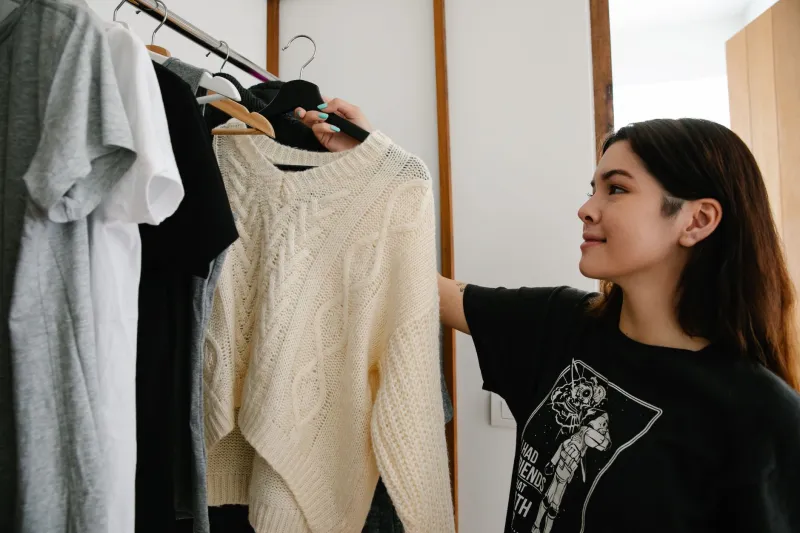
There's a leather jacket in the back of my closet that I haven't worn in three years. It fits perfectly. The zipper works. It's not damaged, not dated, not anything — except entirely wrong for who I am right now. And every time I move it aside to get to something else, I feel this little pang. Not quite guilt. Not quite grief. Something in between.
I call it outfit archaeology — that experience of digging through your closet and uncovering artifacts from a previous version of yourself. The blazer you wore to your old job. The going-out top from your early twenties. The dress you bought for a relationship that didn't last. These pieces aren't broken. They're just... from another chapter.
And figuring out what to do with them? That's genuinely hard.
Why We Hold On (And It's Not Always About the Clothes)
Here's the thing nobody says out loud: keeping clothes from a past version of yourself is sometimes less about the clothes and more about not being ready to fully close that chapter. The corporate wardrobe you stopped needing when you went freelance. The athleisure phase that defined a particular season of reinvention. The "going out" rotation from before kids.
Clothing carries identity. That's not sentimental nonsense — it's actually how our brains work. We attach meaning to objects that were present during significant moments, and clothes are uniquely personal because they were literally on our bodies during those experiences. So when you hold onto that going-out top, you're not just keeping a shirt. You're keeping a feeling, a version of freedom, a memory of who you were at 26 on a Friday night in the city.
The problem is when holding onto those pieces becomes a way of avoiding the fact that life has genuinely shifted. When the closet becomes a museum to former selves instead of a functional tool for the person you actually are today.
The Question That Changes Everything
Most closet-editing advice tells you to ask, "Does this spark joy?" or "Have you worn it in the last year?" But for clothes tied to identity, those questions miss the point entirely. Something can spark joy as a memory and still have no place in your current wardrobe. Something can be unworn for three years and still be worth keeping.
The question I find more useful is this: Does this piece belong to who I was, or does it belong to who I'm still becoming?
That distinction matters. Some clothes from past chapters actually do have a future in your wardrobe — because they reflect a part of your taste that hasn't disappeared, just evolved. A vintage find from your early thrift-store days might still feel like you, even if the context around it has changed. Those are worth keeping.
But some pieces are genuinely backward-facing. They represent a version of yourself you've moved away from — not temporarily, not reluctantly, but intentionally. Those are the ones quietly creating static in your closet, making it harder to see and reach for what actually serves your life now.
A Framework for Sorting Through It Honestly
When I work through my own closet (and yes, I do this seasonally, even when I don't want to), I run anything emotionally complicated through a simple three-part check:
1. Is this about the piece, or about the period? Ask yourself whether you love the actual item or whether you love what it represents. If you're honest and the answer is mostly the latter, that's important information. You can honor a chapter of your life without keeping every costume from it.
2. Would you buy this today? Not "would you buy it if you were going back to that job" or "would you buy it for a version of your life you're hoping to return to." Would you buy it for the life you're actually living right now, this month, in your real circumstances? If the answer is no, that tells you something.
3. Is keeping it costing you something? This one's subtle. Sometimes the cost is just physical — space in a small apartment closet is real estate, and every item that doesn't earn its place takes up room something useful could occupy. But sometimes the cost is psychological. If seeing a piece regularly makes you feel behind, or stuck, or like you're failing to be who you used to be, that's a cost worth acknowledging.
What to Do With the Ones You're Releasing
Once you've identified pieces that genuinely belong to a past chapter, the next step is releasing them in a way that doesn't feel like erasure. Because that's often the resistance — it feels like getting rid of the jacket means getting rid of the memory, or dismissing who you were.
It doesn't. Here are a few approaches that actually help:
- Document before you donate. Take a photo of the piece. Write a sentence or two in your phone's notes about what it meant to you. This sounds small but it genuinely helps your brain let go of the object while keeping the memory.
- Donate with intention. Thrift stores, clothing swaps, Buy Nothing groups, women's shelters that accept professional wear — knowing a piece is going somewhere useful makes the release feel purposeful rather than wasteful.
- Keep one, not ten. If you have an entire era of your life represented in your closet, you don't have to purge all of it. Pick the one piece that best captures that chapter and let the rest go. That one item becomes a meaningful keepsake. Ten items become clutter.
- Give it a real deadline. If you genuinely can't decide, give yourself 90 days. Put it somewhere accessible. If you don't reach for it once in that window, you have your answer.
Making Room for Who You Are Now
The goal of all this isn't minimalism for its own sake. It's not about having fewer clothes or following some arbitrary rule about capsule wardrobes. It's about making sure the space you get dressed in every morning actually reflects and supports the person you are today — not the person you were five years ago, and not some aspirational future self who lives a completely different life.
When your closet is cluttered with past chapters, getting dressed becomes subtly exhausting. You're constantly navigating around things that don't apply, which makes it harder to see the things that do. Clearing that out isn't loss — it's clarity.
The leather jacket is still in my closet, for the record. I'm not quite ready. But I know why I'm keeping it now, and that's different from before. When I let it go — and I think I will, eventually — it'll be a deliberate choice, not a default. And that feels like the right way to do it.
Your wardrobe should be a reflection of your actual life, not a archive of every life you've ever lived. Give the current version of you the closet she deserves.