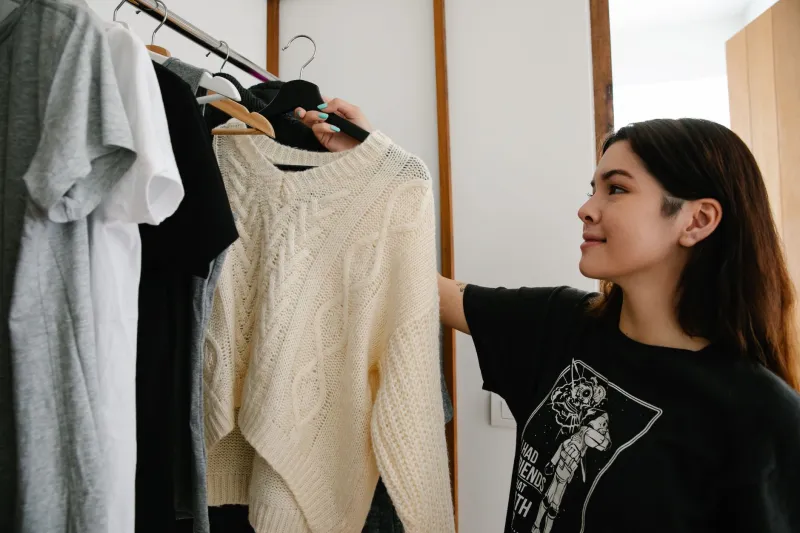
Your Body Wrote a New Chapter—It's Time Your Wardrobe Caught Up

Most of us have a ghost wardrobe. It lives in the back of the closet, in the bins under the bed, in the section of hangers we skip past every morning. These are the clothes from a different version of ourselves—pre-pregnancy, pre-pandemic, pre-the-decade-that-changed-everything. And we keep them around because letting go feels like admitting something we're not quite ready to admit.
Here's what I want to say upfront: your body changing is not a before-and-after story. It's not a problem with a solution waiting at the end of a diet or a fitness plan. Bodies shift because of pregnancy, age, injury, illness, medication, stress, muscle gain, lifestyle changes—because of life. And a wardrobe that fights that reality instead of working with it is going to lose every single morning.
This is about recalibration. Not a closet overhaul driven by shame. A thoughtful, honest reset driven by practicality and a little self-respect.
The Audit That Doesn't Make You Feel Terrible
Most closet cleanout advice starts with the Marie Kondo question: does it spark joy? Which is lovely in theory and completely useless when you're staring at jeans you loved in 2019 that now don't zip. Of course they don't spark joy right now. That's not a useful data point.
Instead, try a different audit framework. Pull out everything and sort it into three questions:
Does it fit my body as it is today—comfortably, not aspirationally? Not "it fits if I don't breathe too deeply" or "it fits if I wear the right shapewear." Actually fits, in a way that lets you move through your day without thinking about it.
Does it fit my actual life right now? A wardrobe full of work blazers doesn't serve you if you're working from home three days a week. A closet of weekend casual doesn't help if you've gone back to a client-facing office role. Life shifts, and so do the demands on your clothes.
Does wearing it make me feel like myself? This one is subtler. Sometimes a piece fits perfectly but belongs to a version of you that doesn't quite exist anymore. Not worse, not better—just different. That's okay to acknowledge.
Anything that fails all three questions is a strong candidate to go. Anything that fails one or two might just need some attention.
Adapting Favorites Instead of Abandoning Them
Not every piece that doesn't quite work right now needs to leave. Some things are worth adapting, and this is where people leave a lot of value on the table.
Tailoring is genuinely underused in the US compared to how widely it's practiced elsewhere. Most people think of tailoring as something you do for special occasion pieces—a wedding dress, a suit. But a good tailor can let out a seam, take in a waist, drop a hem, or reshape a shoulder on everyday pieces for $15–$50 in most cities. That blazer you love but that's now pulling across the back? Might be a $30 fix.
Also worth considering: how you style something can completely change whether it works on your body as it is now. A dress that used to work as a fitted silhouette might now be better belted at the waist and worn over straight-leg pants. A button-down that gaps at the chest can be worn open as a layer over a fitted tank. The piece isn't necessarily done—it might just need a new context.
Before you donate, spend ten minutes on Pinterest or even just in your own mirror experimenting with different ways to wear a piece. You might be surprised.
Building Flexibility Into Your Wardrobe Going Forward
One of the most practical things you can do when your body is in a period of change—whether that's postpartum, mid-transition from one fitness level to another, or just navigating the general drift of your thirties and forties—is to shop for flexibility rather than precision.
This means:
Prioritizing adjustable silhouettes. Wrap dresses, drawstring waists, elastic-back trousers, and tie-front tops all accommodate a range of sizes and body shapes without looking like they're trying to. They're not "plus size" or "maternity" or any category—they're just smart construction.
Investing more in tops and less in bottoms during transition periods. Tops are generally more forgiving across size changes than bottoms. If you're in a body flux moment, it makes sense to spend on quality pieces in your top half and be more budget-conscious about bottoms until things settle.
Choosing stretch fabrics strategically. Not everything needs to be stretchy—but for workwear and everyday pieces, a small percentage of elastane in the fabric blend makes a meaningful difference in longevity and comfort across body fluctuations.
Buying for who you are right now, not who you're planning to be. This is the hardest one. It feels wasteful to invest in clothes for a body you're hoping to change. But wearing clothes that don't fit you today creates daily friction and low-grade discomfort that adds up. You deserve to feel good in what you're wearing right now, today, in this body.
The Emotional Side Nobody Talks About Enough
Let's just name it: there's grief involved in some of this. Grief for a body that felt easier, for clothes that represented a particular time in your life, for a version of yourself you were attached to. That's real, and it doesn't need to be rushed past.
But there's a difference between honoring that grief and letting it run your closet. Keeping jeans two sizes too small as a "goal" piece tends to function less as motivation and more as a daily reminder of where you're not. Most stylists and therapists who work at the intersection of body image and clothing will tell you the same thing: dress the body you have. The confidence that comes from feeling well-dressed in the present moment is worth more than the hypothetical confidence of fitting into something old.
Where to Start if You're Overwhelmed
If the whole closet feels like too much, start small. Pull out just your everyday basics—the pieces you reach for most often. Do those fit well? Do they feel good? If not, that's your first priority. Get those right before you worry about the rest.
From there, work outward. Special occasion, workwear, seasonal pieces. Take your time. This doesn't have to happen in a weekend.
And when you're ready to shop for new pieces, shop with intention. Know what gaps you're filling. Know what silhouettes work for your body right now. Give yourself permission to find that out through trying things on rather than ordering based on what worked before.
Your wardrobe is supposed to serve you. Not the other way around. When it stops doing that—because life happened, because your body changed, because you changed—it's not a failure. It's just time for an update.